
The platform clock at Park Sanssouci station was running three minutes fast, and I was still deciding whether the 10am slot I’d booked for the palace was worth the train from Berlin. By the time I’d bought my ticket, checked the renovation notices at the information desk, and found the entrance to the park, the answer had taken care of itself: yes, but only if you treat the whole complex as a walk, not a list of sights.
Sanssouci is the name Frederick the Great, King of Prussia, gave to his hilltop summer retreat, from the French for “without worries.” The complex on the edge of Berlin’s western suburbs is a UNESCO World Heritage Site, and it spans nearly 300 hectares of terraced vineyards, parks and palaces. It is not, however, a place you can see in four hours from a tour bus. I spent half a day here and still didn’t get to everything, which is exactly the point.
What it’s like to actually walk Sanssouci
Start with the honest logistics, because the first thing the brochures don’t tell you is that the place is big. My walking route through the main sights covered about 7km (4+ miles), and that’s with a couple of shortcuts I took through the park rather than following the formal paths. There are only a handful of eateries in the whole complex, and they’re all at the edges, so bring water and a snack.
Buy the day ticket for the palaces when you arrive. Entrance to Sanssouci Palace itself is restricted to timed slots, and I’d recommend booking the earliest one you can get. The other buildings and monuments in the park are open to wander at your own pace, so the slot system really only affects one stop.
On transport: you can day-trip from Berlin, which plenty of people do, but I’d rather have one or two nights in Potsdam. The park deserves a slow pace, and Potsdam’s city centre is worth an evening on its own. From the New Palace you can catch the train back to Potsdam Hbf, or take bus 695 at Maulbeerallee into the town.
The route: where to start and what to skip
I’m not going to give you a numbered list, because the park works best as a loop you adjust as your legs feel. Here is the order I actually walked it in, which took me a solid half day.
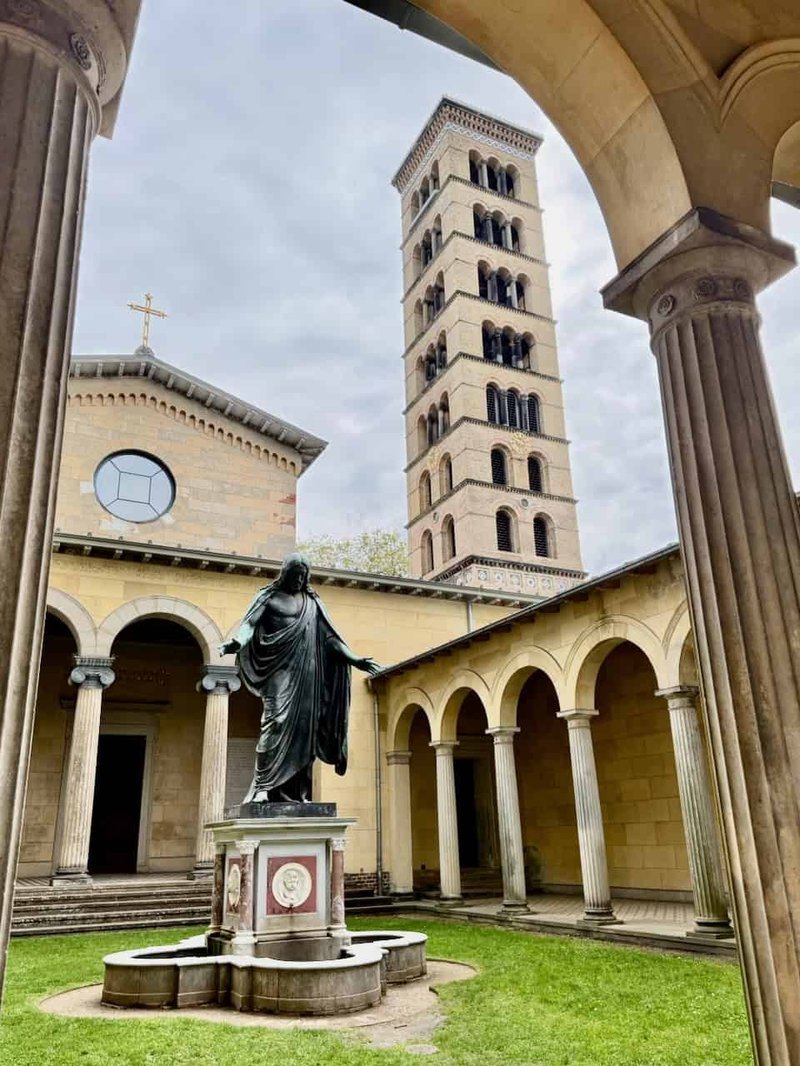
Start at the Emperor Frederick Mausoleum, next to the Friedenskirche (Church of Peace). It’s the quietest building in the park and a good place to set a slow tone before the crowds of the main palace kick in.
Then walk up the park to Sanssouci Palace. Book the earliest slot I could get, which was 10am, and you’ll have the terraces to yourself for a while after. From the palace, head down to the historic windmill and past the New Chambers, then cross the Sicilian gardens to the Chinese House.
From here the route splits, and this is where you make a trade-off. If you have time, continue to the Roman Baths and then Charlottenhof Palace. If not, head straight to the New Palace, which is where you’ll exit onto the train.
One honest warning: as of June 2026, the Roman Baths and the Orangery Palace are both closed for renovation. I checked the notices before going, and I’d do the same, because a closed Orangery is a long detour for nothing.
The mausoleum and the 99-day emperor
The Emperor Frederick Mausoleum is easy to miss if you’re only here for the palaces, and that’s a shame, because it’s the most quietly interesting building in the park. It was built between 1888 and 1890 as the final resting place of Emperor Frederick III and his wife, Empress Victoria, the eldest daughter of Britain’s Queen Victoria.
Frederick III is the one I always get wrong on a quiz: he’s the “99-day emperor.” He took the throne in 1888 and died of throat cancer ninety-nine days later, which is why historians keep speculating about how different Germany might have been had he lived. Inside the mausoleum there are marble sarcophagi and some finely carved sculptures, and the whole atmosphere is calm in a way the palaces never quite manage.
Sanssouci Palace: one floor, no throne room
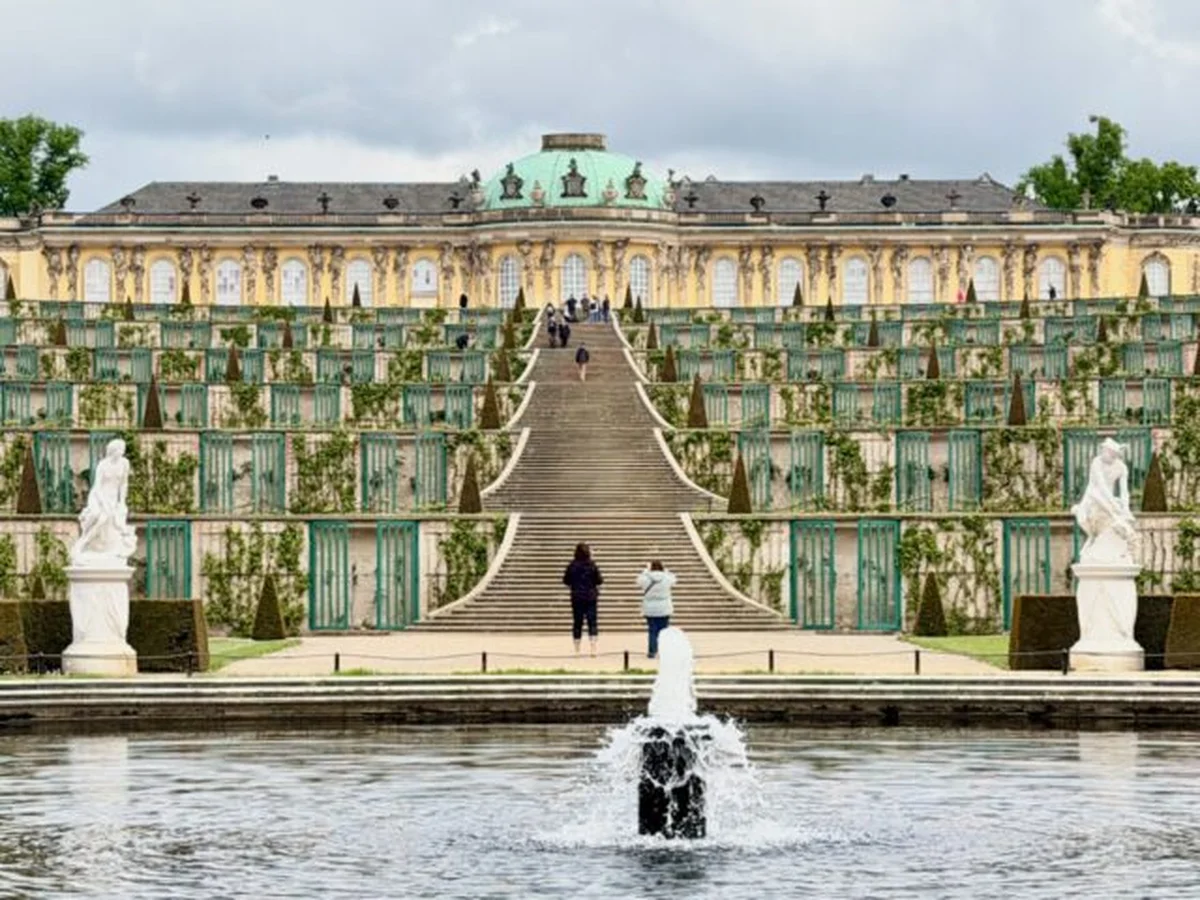
Sanssouci Palace sits on top of the terraced vineyards on the hillside, and it’s the image people have when they hear the name. It was built between 1745 and 1747, and unlike most royal palaces it was designed as a private retreat rather than a stage for foreign dignitaries. Frederick used it to read philosophy, play the flute, and host a small circle of friends. The whole thing is one storey, which is a deliberate statement: comfort over grandeur.
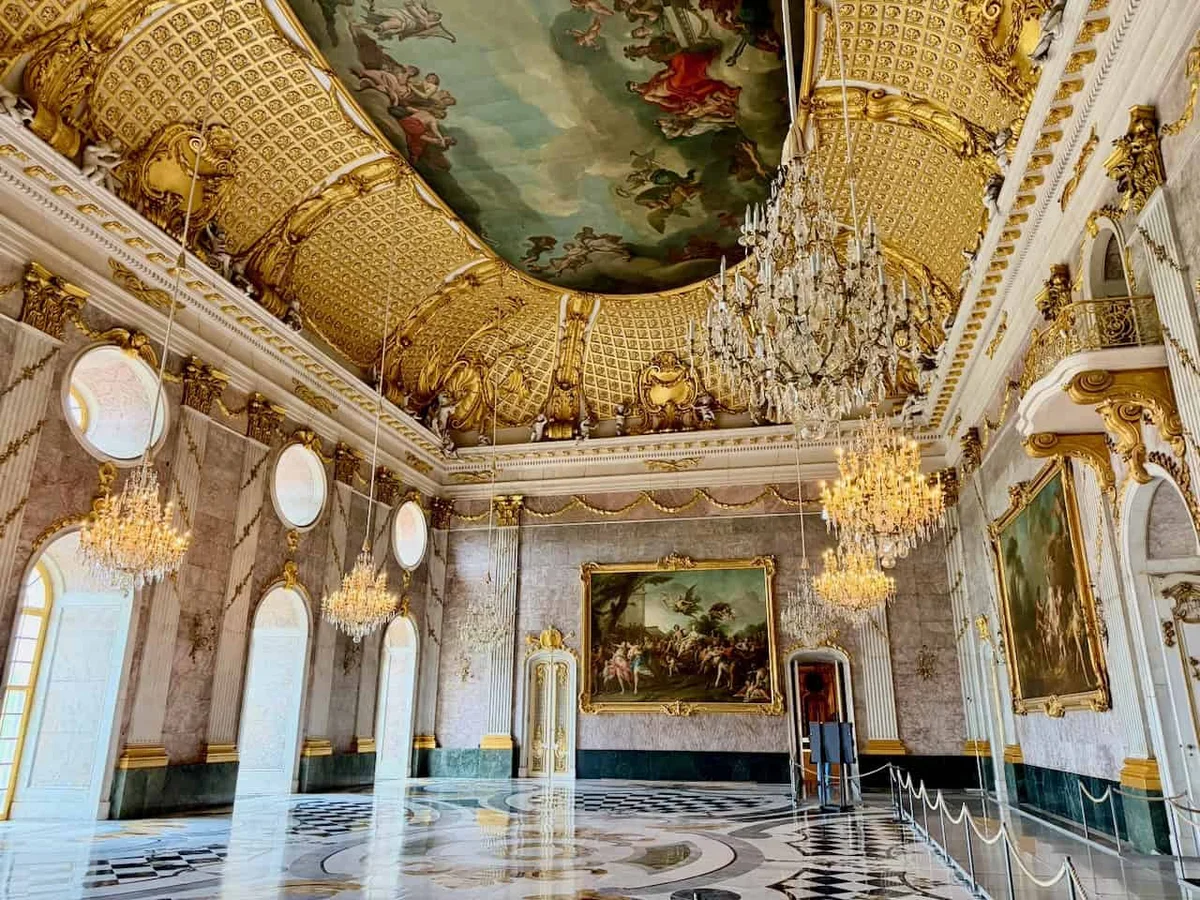
The rooms inside are heavily gilded and ornate, and there’s a Marble Hall where Frederick entertained Enlightenment thinkers, including Voltaire. The Picture Gallery next to the palace, finished in 1764, is considered Germany’s oldest purpose-built museum, and it held Frederick’s collection of paintings by Rubens, Van Dyck and Caravaggio.
One thing I’d tell myself before going: the timed entry is real, and the 10am slot is the one I’d take if I were planning again. The palace is small enough that a full tour takes about an hour, but the lines outside are not small.
The windmill and the miller who told the king off
Below the palace terraces there’s a windmill, and it has a story that I find more charming than any of the palace interiors. The original mill dates from 1738 and belonged to a local miller. Frederick was annoyed by the noise and wanted it, and when the miller refused to sell, the king threatened to just take it by royal authority.
The miller’s reply, according to the Prussian legend, was that there were still judges in Berlin, meaning the king wasn’t above the law. Whether it’s entirely true or partly invented, it stuck around as a symbol of the rule of law in Prussia. The mill was rebuilt in Dutch style in 1787, destroyed in the Second World War, and the replica you see now was finished in the 1990s from old plans. You can go inside and look at the milling machinery.
Chinese House and the New Palace
The Chinese House is a small gilded pavilion built between 1755 and 1764, and it’s the park’s most kitsch building, which is exactly what makes it fun. It’s not Chinese architecture at all, just 18th-century Europe’s idea of what Chinese might look like, and golden statues of musicians and tea drinkers are set around it. I spent longer here than I expected to.
The New Palace is where the tone changes. It was built between 1763 and 1769, right after the Seven Years’ War, as a statement that Prussia could still afford to be spectacular. It’s considerably larger than Sanssouci, with a facade that stretches for hundreds of meters and over 200 rooms inside. The Grotto Hall is the one to see: the walls are covered in thousands of shells, minerals and semi-precious stones, and it takes longer to look at than you’d expect. The Great Marble Hall is the ceremonial centerpiece, and Frederick himself reportedly called the whole building a kind of “fanfaronade,” a display of bravado.
He didn’t live there much. The last German emperor, Wilhelm II, used it as his home until he abdicated in 1918 and took most of the furniture with him to his estate in the Netherlands. The Dutch found it there in the 1970s and sent it back to Potsdam.
If you only have one day, do this
If you’re short on time and can only manage the main line, skip the Roman Baths and Charlottenhof, and give yourself the morning for Sanssouci Palace on the 10am slot and the afternoon for the New Palace. That’s the full loop without the add-ons, and it’s about 7km of walking, which is a lot but doable if you don’t rush the interiors.
If you have a full day, add Charlottenhof in the south of the park. It’s a neoclassical palace designed by Karl Friedrich Schinkel, built in the 1820s for the future Frederick William IV, and it’s the quietest, cleanest building in the whole complex. It’s not as famous as the others, and I’d rather have it than the Orangery on a short trip, especially now that the Orangery is closed.
What I’d do differently
Next time I’d book two nights in Potsdam and do the park in two halves rather than one long push. The second morning, with no palace slot to hit, is where the Chinese House, the windmill and the vineyard paths actually make sense. And I’d check the renovation notices before I commit to the southern add-ons, because a closed building changes the arithmetic of a day.
The park is still the best part, honestly. The terraced vineyards under the palace, the fountains and the long tree-lined paths, that’s what I kept coming back to when the interiors got dense. It’s a place built for walking slowly, and it only works that way.